What Is Added Sugar? Added vs Natural vs Free Sugars, Explained
Added sugar is any sugar or syrup put into a food during processing, cooking, or packing. The FDA counts sugars added in production, sweeteners sold on their own such as table sugar, sugars from syrups and honey, and sugars from concentrated fruit or vegetable juices. It does not count the sugar already sitting in plain milk, fruit, and vegetables.
So what is added sugar in practice? It is the sweetness a factory, a cook, or you put in. That one idea covers the table sugar in a cookie, the honey in a granola bar, and the apple juice concentrate used to sweeten a cereal.
There is one wrinkle. The US food label and the World Health Organization draw the line in slightly different places, and that is where most of the confusion starts.
What is added sugar, natural sugar, and free sugar? The 30-second version
Three terms get used for the same idea, and they do not mean the same thing.
- Added sugars are sugars put into a food by whoever made it. This is the term printed on the US Nutrition Facts label.
- Natural sugars are the sugars already present in a whole food. The fructose in an apple and the lactose in plain milk both count.
- Free sugars is the WHO and NHS term. It covers added sugars plus the sugars in honey, syrups, and fruit juice, even when nobody added them.
The gap between the last two trips people up. A glass of 100% orange juice has no added sugar by the US label. Its sugars are still free sugars under WHO guidance, because juicing strips the fruit of its structure.

| Term | What it means | Who uses it | Examples that count | Examples that do not |
|---|---|---|---|---|
| Added sugars | Sugar put into a food during processing or packing. | The FDA, on the US Nutrition Facts label. | Table sugar, honey, maple syrup, juice concentrate used to sweeten. | Lactose in plain milk. Sugar in whole fruit. |
| Natural sugars | Sugar already in a whole food before anyone touches it. | Everyday language. It is not a line on any label. | Fructose in an apple. Lactose in plain milk. | Anything a recipe or a factory stirs in. |
| Free sugars | Added sugars plus the sugars in honey, syrups, and fruit juice. | The WHO and the NHS, in dietary guidance. | Table sugar, honey, 100% fruit juice, smoothies. | Sugar inside whole fruit. Lactose in plain milk. |
Neither body is wrong. The FDA is writing a rule a factory can follow on a package. The WHO is writing dietary advice about what happens once the fibre is gone.
What counts as added sugar, and what does not
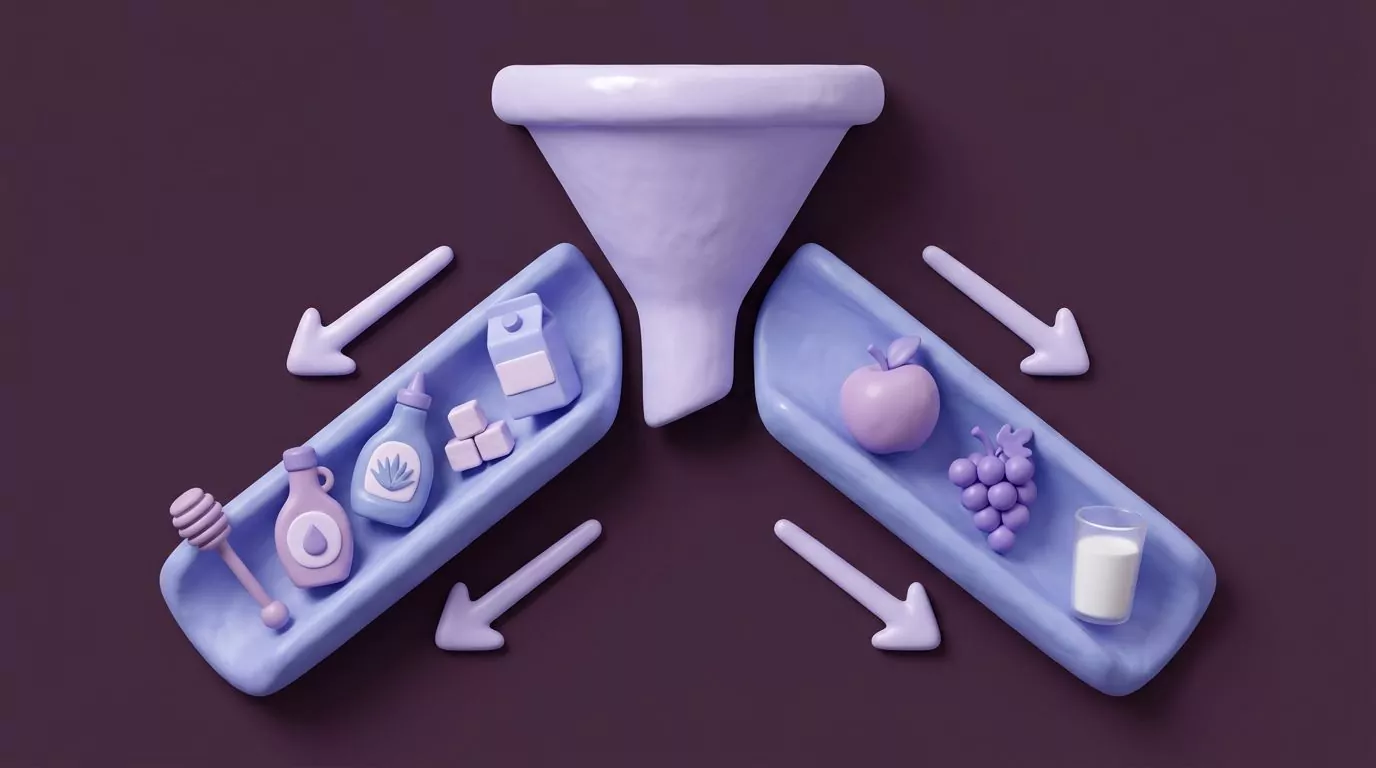
The FDA list is short and specific. These count as added sugars on a US label:
- Sugars stirred in during production, such as sucrose or dextrose.
- Foods packaged as sweeteners, such as table sugar, brown sugar, and coconut sugar.
- Sugars from syrups and honey, including maple syrup and agave.
- Sugars from concentrated fruit or vegetable juices used to sweeten something.
These do not count:
- Lactose, the sugar in plain milk, yogurt, and unsweetened dairy.
- The sugar inside a whole apple, a banana, or a carrot.
- Frozen or canned fruit packed in water with nothing added.
The edge cases people ask about
100% fruit juice. A carton of straight juice carries no added sugars in the US. The WHO and the NHS still count those sugars as free sugars. Both statements are true at once.
Juice concentrate in an ingredient list. This one flips. When a maker uses concentrated apple or grape juice to sweeten a bar or a yogurt, the FDA does count it as added sugar.
Smoothies. Blending keeps the fibre, so a home smoothie is gentler than juice. The NHS still treats the sugars in a shop-bought smoothie as free sugars.
Dried fruit. Plain raisins and dates have no added sugar. The sugar is simply concentrated because the water left. Check the pack anyway, since many dried cranberries are sweetened. The fruit sugar chart lists sugar per serving for 50 or more fruits.
Total sugars vs added sugars on the Nutrition Facts label
The US label shows two sugar lines, and they are not alternatives. Total Sugars is everything. The indented line below it, worded Includes Xg Added Sugars, is the slice of that total someone put in.
The word includes matters. Added sugars are already inside the total, so you never add the two numbers together.

A worked example: plain yogurt vs flavoured yogurt
Plain yogurt shows sugar on the label even though nothing was sweetened. That sugar is lactose from the milk. Total Sugars might read 8g, with added sugars at 0g.
Now take a sweetened tub. The FDA uses exactly this example: a yogurt showing 15g Total Sugars with an Includes 7g Added Sugars line. So 7g came from a sweetener and 8g came from the milk. That 7g works out at 14% of the Daily Value.
The Daily Value is the fastest shortcut on the panel. The FDA rule of thumb: 5% DV or less of added sugars is low, and 20% DV or more is high. You can judge a product in seconds.
One exception catches people out. Packs of single ingredient sweeteners such as table sugar, honey, and maple syrup show only the %DV, with the grams often in a footnote. That stops the label suggesting sugar was added to sugar.
If a panel still looks confusing, paste it into the food label sugar decoder. It reads the total and added lines for you and explains the gap between them.
Why the added sugar distinction actually matters
Every major health body sets its limit on added or free sugars, never on total sugars. Nobody is asking you to count the lactose in your milk or the fructose in a pear.
Here is where the guidance lands for adults:
- WHO: keep free sugars under 10% of daily calories. Going below 5%, roughly 25g a day at 2,000 calories, brings further benefit.
- AHA: no more than 25g (about 6 teaspoons) a day for most women, and 36g (about 9 teaspoons) for most men.
- NHS: no more than 30g of free sugars a day for adults, roughly 7 sugar cubes.
- FDA: the Daily Value on the label is 50g a day, based on a 2,000 calorie diet.

Most people land well above all of those. Federal tracking data puts US average intake at 13.2% of calories, about 66g a day at 2,000 calories.
Sugar in a whole apple arrives wrapped in fibre and water, so you fill up before you overshoot. The same grams in a drink arrive with nothing attached.
Grams are also hard to picture. One teaspoon is about 4.2g and one sugar cube about 4g, so a 330ml cola at roughly 35g is more than eight teaspoons. The sugar grams to teaspoons converter does that swap instantly.
None of this puts a single food off limits. The FDA is explicit that some added sugar fits inside an overall healthy eating pattern.
How to spot added sugar in an ingredient list
The added sugars line tells you how much. The ingredient list tells you what form it took, which matters when a product spreads its sugar across several names.
- Words ending in ose. Sucrose, dextrose, maltose, and fructose are all sugars.
- Anything called a syrup. Corn syrup, rice syrup, malt syrup, and golden syrup all qualify.
- Juice concentrates. Apple or grape juice concentrate used as a sweetener counts.
Order matters too. Ingredients are listed by weight, so a sweetener near the top means there is a lot of it. Splitting one sweetener into three pushes each further down the list.
Sugar answers to more than 70 names, and nobody memorises them. Pasting a list into the hidden sugar finder highlights every one in a second.
Frequently Asked Questions
Is honey an added sugar?
Yes, in both systems. The FDA counts sugars from honey and syrups as added sugars whenever honey goes into a product. The WHO counts honey as a free sugar even when you spoon it on yourself. A jar of honey is the special case: its label shows the %DV instead of a gram line.
Is fruit sugar the same as added sugar?
Not when the fruit is whole. The fructose in an apple is a natural sugar, and no guideline asks you to count it. That changes once the fruit is juiced or concentrated. Juice sugars are free sugars under WHO and NHS guidance, and juice concentrate used to sweeten a product is an added sugar under FDA rules.
What is the difference between total sugars and added sugars?
Total sugars is every sugar in the food, natural and added together. Added sugars is the smaller portion someone put in, on an indented line starting with the word includes. Total sugars has no Daily Value, because no health body sets a limit for it. Added sugars has one, currently 50g.
Are free sugars the same as added sugars?
They overlap heavily but are not identical. Free sugars is the wider WHO and NHS term. It takes every added sugar, then also counts the sugars in honey, syrups, and fruit juice. Added sugars is the narrower FDA label term, so a glass of 100% juice has free sugars but no added sugars.
How much added sugar per day is OK?
Mainstream guidance clusters between 25g and 50g a day for adults. The AHA suggests 25g for most women and 36g for most men. The WHO suggests staying under 10% of calories, ideally below 5%. The FDA Daily Value is 50g. These are general population guidelines rather than personal advice, so talk to a healthcare professional about your own situation.
Turning the definition into a number you can use
Knowing what added sugar is only pays off once you know your own daily figure. The daily sugar intake calculator turns your calorie needs into a personal limit in grams and teaspoons, using WHO and AHA guidance. It runs in the browser and needs no signup.
Sugar Lens, an added sugar tracking app for iOS, is in development and will log your daily total against that limit once it launches. Both are awareness and tracking tools rather than medical advice.